
Greene County Projected Versus Actual
NCDAC uses two exact labels that answer different questions. Projected Release Date is the agency’s current calculation for a sentence period. Actual Release Date records the event after it occurs. A projected date can change before release. An actual date can remain in a historical period even if a later sentence or return to custody appears elsewhere in the record.
Do not treat a location change as an actual release. Greene County contains three state prisons, and movement among Greene Correctional Institution, Eastern Correctional Institution, Maury Correctional Institution, a hospital, or another NCDAC facility continues state custody. Read Inmate Status, Current Location, Previous Location, Last Movement Date, Service Status, and the sentence panel together. An inactive inmate status with an Actual Release Date and active post-release status supports physical release into the community under continuing supervision.
| Date or field | What it answers | What it does not prove |
|---|---|---|
| Booking date | When a county jail episode began | A sentence start or release date |
| Sentence begin date | Start of a sentence calculation period | The day a person first entered all custody |
| Projected Release Date | Current expected point under the sentence calculation | That release has occurred |
| Actual Release Date | Recorded release event for that period | Full discharge from all supervision or later cases |
| Last Movement Date | A change in location or status handling | Release into the community |
| Supervision end date | Administrative end field for a community term | The physical prison-release date |
Find Greene County Projected Dates
The correct route depends on who holds the person. State-prison dates appear in NCDAC Offender Public Information. The database covers prison, probation, and parole records, including historical information back to 1972, but it excludes ordinary county jail data. Greene County Detention Center and the court are the proper sources for a county jail sentence or a pretrial booking.
- Identify the custodian. Separate Greene County Detention Center from the three NCDAC prisons located in the county.
- For a state prisoner, search OPI by offender number when possible. Otherwise use the name and compare a second identifier.
- Open the correct record and select the sentence period tied to the relevant commitment. Do not assume the newest panel is the one at issue.
- Read Sentence Begin Date, minimum and maximum terms, Service Status, Projected Release Date, Actual Release Date, and parole or supervision dates.
- Check Current Location, Previous Location, and Last Movement Date for a transfer that might look like release.
- For a county sentence, ask the detention center or sentencing court for the controlling calculation, jail credit, and recorded holds.
OPI can show more than one incarceration or supervision period. Each may have its own sentence number, commitment type, conviction date, county, punishment type, minimum and maximum, projected date, actual date, and parole fields. Tie the answer to the correct sentence number. A valid Actual Release Date in an older period remains historical fact, but it does not prove the person stayed out of custody. The official NCDAC OPI search form provides the state-record entry point shown below.
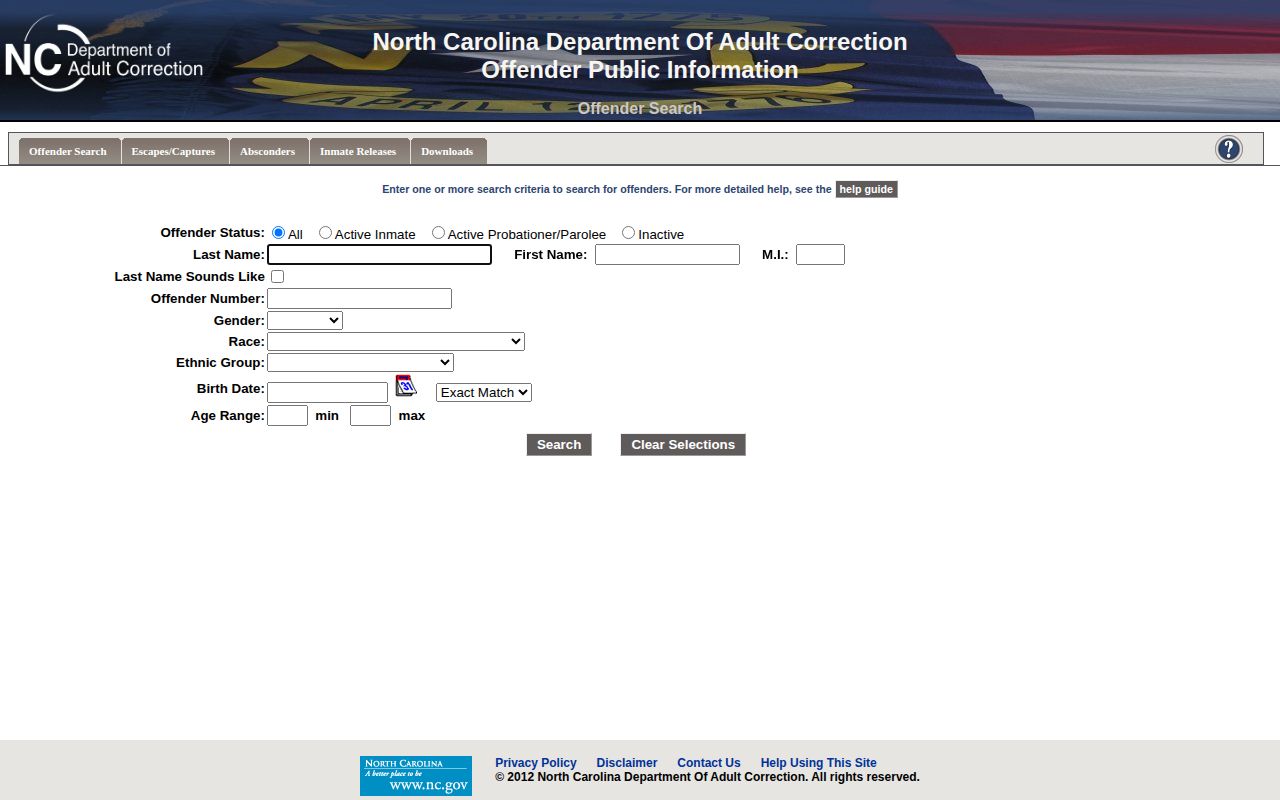
The form can locate a sentenced state prisoner, but the person record and correct sentence panel contain the projected and actual date fields.
Note: Use an offender number when available because a similar name can lead to the wrong sentence and the wrong projected release date.
Greene County Release Date Inputs
A valid calculation begins with the governing sentencing regime and offense date. Next come the judgment’s minimum and maximum terms, the order of concurrent or consecutive sentences, jail credit, sentence start, and any authorized earned credit. “Concurrent” means terms run at the same time. “Consecutive” means one term follows another. Pre-sentence jail credit may affect the credited service but does not turn the booking date into every sentence’s start date.
Holds and detainers must be checked after the sentence calculation. A detainer is another authority’s request or legal basis to take custody when the present custodian would otherwise release the person. Thus, completion of an NCDAC term can lead to another jail, federal authority, or immigration custody rather than the community. A new commitment, correction to the judgment, appeal, or revocation can also alter the sequence.
- Minimum term
- The floor imposed for a Structured Sentencing felony, subject to the controlling law and judgment.
- Maximum term
- The upper sentence term against which authorized earned time can operate.
- Jail credit
- Credited confinement recognized in the sentence computation.
- Earned time
- Credit awarded under authorized correctional rules, not an automatic percentage applied to every case.
- Detainer
- A claim by another authority that can change where the person goes when the current term ends.
An abstract calculation has several steps: read the court minimum and maximum, identify any jail credit, determine how multiple terms run, apply only credit allowed for that sentence, check new orders and holds, and then compare the result with OPI. The agency or jail custodian remains the authoritative calculator. Do not publish a self-made date as if it were official.
No Universal 85 Percent Rule
North Carolina does not support a blanket statement that every person serves 85 percent of a sentence. For Structured Sentencing felonies, the court imposes a minimum and maximum. G.S. 15A-1340.13(d) allows earned time to reduce the maximum term, but not below the minimum. The practical truth-in-sentencing floor is service of that minimum, not a universal percentage formula.
Other sentence types follow different rules. G.S. 15A-1340.20(d) caps misdemeanant earned-time credit at four days per month. G.S. 15A-1355(c) links felony and misdemeanor credits to their respective provisions, while impaired-driving credits follow separate rules. G.S. 148-13 requires NCDAC credit rules and directs distribution of those rules to local jail administrators for sentenced jail prisoners.
These provisions do not operate identically for pretrial detention, special probation, impaired-driving sentences, and every historical sentencing system. The offense date and judgment control the framework. A percentage calculator that ignores the minimum term, sentence type, jail credit, and holds can be wrong even when its arithmetic is neat.
Post-release supervision is a separate community phase, not added prison time during ordinary compliance. G.S. 15A-1368.2 governs its eligibility and procedure. A person can be physically out of prison while OPI still shows active state supervision. Revocation can later produce a new incarceration period and Actual Release Date.
Greene County Release Date Changes
A projected date is calculated from facts that may change. Some changes affect sentence credit. Others alter the judgment, add a custody claim, or create a later commitment. The reason should come from the agency or court record rather than speculation based on a date moving forward or backward.
| Factor | Possible effect | Record to check |
|---|---|---|
| Earned-time award or forfeiture | Changes credit applied within the lawful sentence limits | NCDAC calculation and Projected Release Date |
| Jail-credit correction | Changes credited pre-sentence confinement | Judgment, clerk record, and custodian calculation |
| Concurrent or consecutive correction | Changes the order and combined span of terms | Judgment and sentence panels |
| Appeal or corrected order | Can modify the sentence basis | Court docket and amended judgment |
| Detainer or another hold | May change destination even when the term ends | Custodian movement record and receiving agency |
| Revocation or new commitment | Can create later custody and a new date | Court, Commission, and OPI history |
Parole requires separate care. For eligible older-law cases, the Commission’s decision can affect release, but North Carolina does not publish a conventional formal hearing calendar or a person-by-person decisions portal. Ordinary Structured Sentencing convictions for offenses on or after October 1, 1994 do not use parole. Do not insert a guessed parole date into a Structured Sentencing calculation.
Greene County Jail Date Questions
A pretrial detainee at Greene County Detention Center generally has no computed sentence-release date. Timing may depend on bond, conditions of release, a court order, dismissal, judgment, or another agency’s hold. Even after legal authority is entered, the county publishes no daily release-processing hour. It also publishes no Greene-specific weekend or holiday early-release rule. Do not claim that a Sunday expiration automatically moves to Friday.
For a sentenced county-jail term, call the detention center at 252-747-4700 and ask for the custodian’s calculation. The clerk’s judgment can confirm the sentence, jail credit, and whether terms are concurrent or consecutive. If the person has already left, request the existing release or movement entry, including actual date and time, release type, legal authority, and receiving agency if transferred. The official county page names Matt Sasser as Greene County sheriff, and his office is the county-jail route rather than the NCDAC record custodian.
Greene County’s jail also houses people for neighboring counties and participates in the Statewide Misdemeanor Confinement Program. Physical presence in Snow Hill does not prove that Greene County imposed or controls every sentence. Ask which county committed the person and which authority controls release.
If the jail gives a projected date by phone, record who supplied it and when, then ask what could still change it. The county has not published a fixed processing interval, fee, or turnaround for a release-record request. A written request may seek the existing calculation or movement entry, but it should not demand that staff create a fresh sentence analysis. When another county committed the person, the judgment and committing authority may be needed alongside the Greene custody record.
Note: Courthouse business hours do not establish jail release hours, weekend processing, or the time a person will reach the community.
Confirm Greene County Actual Release
When the date approaches, monitor the official record rather than treating the projection as a promise. NC SAVAN through VINELink can provide a custody-change alert, but notifications follow agency transmission. The Greene County VINE Inmate Check explains how to register and why the reporting agency must be recorded.
After a state release, return to OPI. Find the Actual Release Date for the correct sentence period, confirm the inmate status, and check whether probation, parole, or post-release supervision is active. If the event was a transfer, the Current Location and Last Movement Date should point toward continued custody. For a county release, use the jail entry and court record.
A precise conclusion names its limit: released from which agency, on which actual date, and into the community or to which receiving custodian. If only a projected date is available, describe it as projected. That wording prevents an estimate from being repeated as a completed event.
If an OPI field appears wrong, send a focused correction request to the record custodian. Identify the offender number, sentence number, record URL, disputed field, claimed correct value, and an official supporting document such as a judgment or amended order. A search engine cannot correct the source calculation. Keeping the request tied to one sentence period also avoids changing a valid historical date that belongs to a different commitment.