
Greene County Supervision Types
North Carolina uses three distinct community statuses. The NCDAC Division of Community Supervision administers probation, parole, and post-release supervision. Each can place a person in the community under rules, yet each starts for a different legal reason. A person shown as an active probationer is not necessarily a former state prisoner. Someone with an Actual Release Date and active post-release status has left prison but has not fully ended NCDAC authority.
The distinction matters when reading a Greene County supervision record. Probation is imposed by a court. Parole is discretionary release for eligible sentences, mainly older-law cases. Post-release supervision is the required community phase for covered Structured Sentencing prison terms. None of these labels alone states where a person lives, whether every court matter has ended, or whether a later custody episode exists.
| Status | How it begins | Best verification |
|---|---|---|
| Probation | A court orders community supervision, sometimes instead of active confinement. | Judgment plus an active NCDAC supervision record. |
| Parole | The Commission grants conditional release for a parole-eligible sentence. | Commission information and OPI parole dates or status. |
| Post-release supervision | A covered prison term moves into its required community phase. | OPI Actual Release Date plus active post-release status. |
- Discharge
- The end of the displayed term of correctional authority, subject to checking for another active record.
- Revocation
- A formal action that can return a supervised person to custody after a violation finding.
- Absconder
- A person alleged to be avoiding supervision, which does not by itself prove present jail custody.
Verify Greene County Supervision
The official starting point is NCDAC Offender Public Information, often shortened to OPI. The search covers state prisoners, probationers, and parolees, with historical information dating back to 1972. It does not contain ordinary Greene County jail records. If the custody history is unclear, search broadly first and then inspect each matching record. An offender number is safer than a common name.
- Select Active Probationer/Parolee when current community supervision is likely. Use All when the status is uncertain.
- Enter the offender number when known. Otherwise use the full name and compare birth date, middle initial, sex, race, or other displayed identifiers.
- Open the correct person record. Read both Inmate Status and Probation/Parole/Post Release Status before deciding the person is out of custody.
- Review the supervision and sentence panels. Note punishment type, sentence type, begin and end dates, parole dates, county of conviction, and supervising location if shown.
- Confirm current office or reporting details through the live Community Supervision office directory.
Dates require context. A projected supervision end date is an administrative field, not proof that supervision ended on schedule. Tolling, earned time, violation proceedings, modification, transfer under the Interstate Compact, or revocation can change the record. Current status carries more weight than an old projected end date. If the person has an inactive inmate status but active post-release status, report the two facts separately. The official Community Supervision source shown below identifies the statewide program used for Greene County parole and probation records.
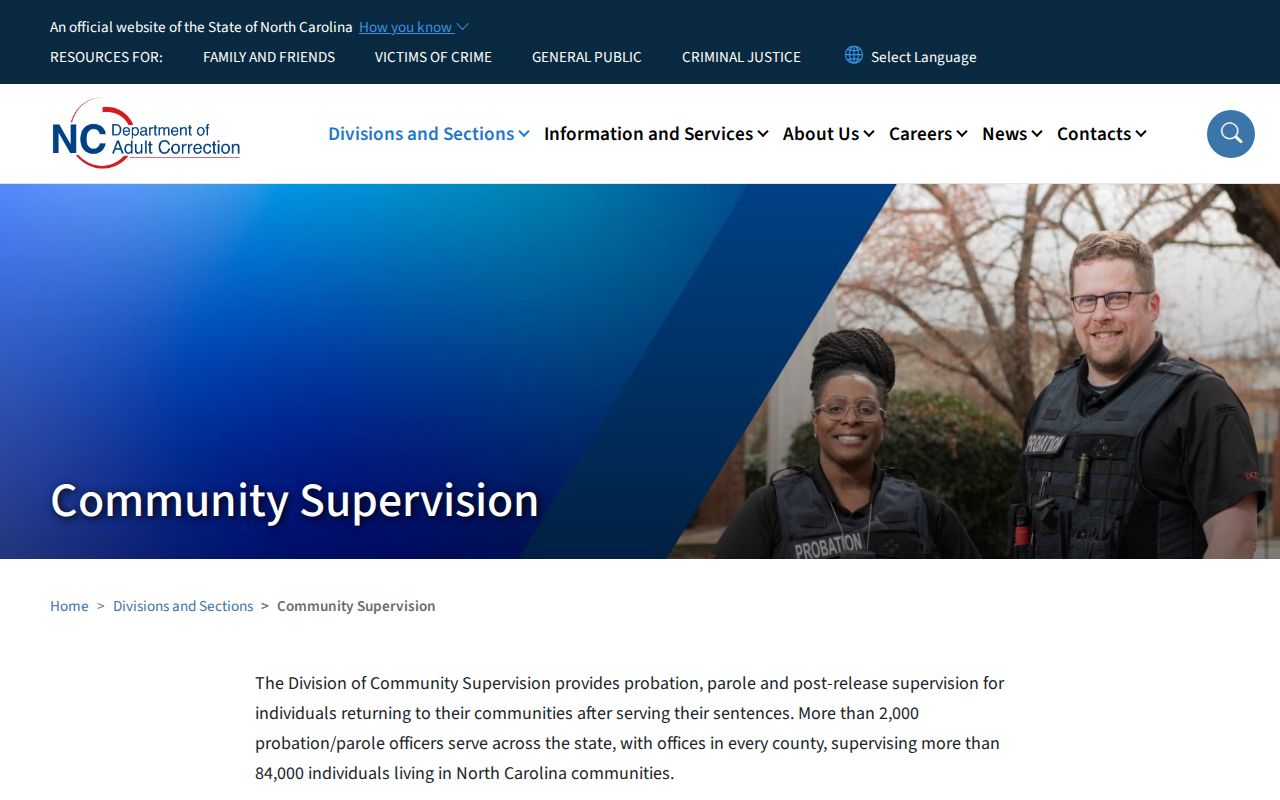
The source helps distinguish a community status from an active prison location, but OPI remains the person-specific lookup.
Note: Record the access date because a current Greene County supervision status can change after an update, violation, discharge, or new commitment.
Greene County Parole Review
North Carolina does not publish a conventional monthly parole hearing calendar. The Post-Release Supervision and Parole Commission says it does not conduct formal hearings or meet personally with people during ordinary parole review. Its parole process and myths and truths pages explain that commissioners examine files individually and vote independently. A majority is needed. There is also no public, person-by-person decisions search comparable to a hearing-results docket.
That process differs from the public hearing model used elsewhere. For Greene County parole status, use OPI and contact the Commission about the individual record. The general eligibility line is tied to offense date: ordinary convictions for offenses committed on or after October 1, 1994 fall under Structured Sentencing, which eliminated parole. Some older-law and impaired-driving sentences can remain eligible under G.S. 15A-1371. Eligibility is only the right to be considered under the governing rules, not a promised release.
2020 Yonkers Road
4222 Mail Service Center
Raleigh, NC 27699-4222
Phone: 919-716-3010
Email: Parole.Commission@dac.nc.gov
A narrow exception allows certain people convicted as juveniles and sentenced to life with parole to appear by video for a limited review. That exception does not create a general Greene County parole calendar. Written notice rules for certain life-sentence reviews also do not create a public online decisions database.
Possible case outcomes include continued review, refusal, investigation toward parole, release under stated conditions, or later modification or revocation. Those descriptions should follow the Commission's language for the individual file. Terms borrowed from another state's hearing system can create a false impression that North Carolina scheduled a public hearing or posted a docket result. For a life-imprisonment consideration covered by statute, certain specified parties may receive notice and a written decision, but that limited notice process is not a public search tool.
Greene County Absconder Records
An alleged supervision violation must not be confused with a new jail booking. NCDAC defines an absconder as a person believed to be actively avoiding probation, parole, or post-release supervision. The agency maintains a separate absconder search, apart from the ordinary OPI person lookup. A result indicates a supervision-status issue. It does not establish that the person is now held at Greene County Detention Center.
Read the warning on the official source. NCDAC notes that a person may remain listed while incarcerated in another state or after death until information is updated. Removal can lag. The public tip line, 888-646-0024, is for location information, not routine questions about release dates or reporting instructions. For a present custody check, use the custodian named in a movement record or call the detention center when Greene County jail custody is plausible.
The official NCDAC absconder form provides the statewide search shown below.
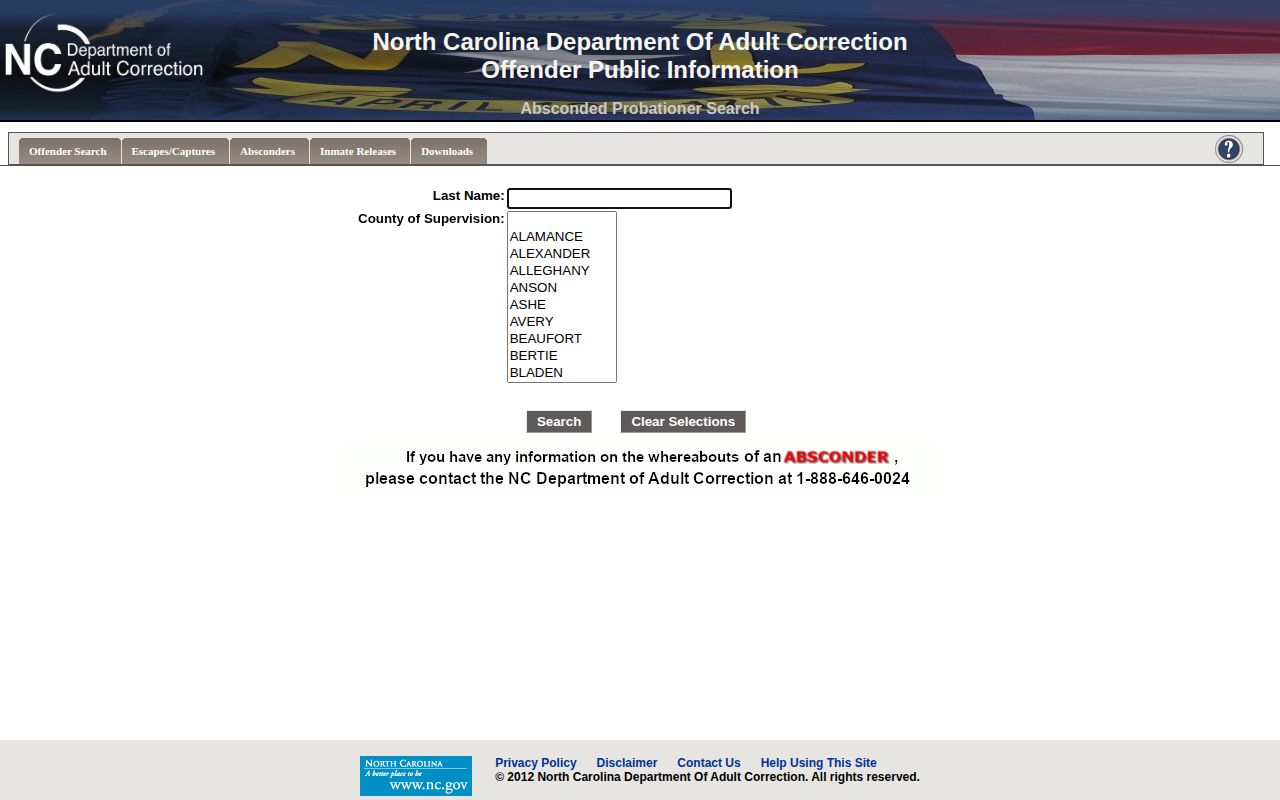
The form should be read alongside the main OPI record so an absconder entry, prison status, and supervision dates are not collapsed into one conclusion.
Greene County Reentry Preparation
Greene County has an unusual place in North Carolina’s release landscape. Greene Correctional Institution is a designated reentry facility. Its official program list includes Strive Transition, work release, home and community volunteer leaves, cognitive intervention, independent study, substance-support groups, and religious services. These programs prepare state prisoners for a return to the community.
The facility’s Greene County location does not mean each person will remain in Greene after release. NCDAC residents come from across North Carolina, and a release plan may return someone to another county. A work-release or community leave entry also does not mean the prison sentence has ended. Confirm the Actual Release Date and the current supervision status in OPI. If post-release supervision follows, the person is physically outside prison while still subject to NCDAC authority.
Local geography can mislead a search. Greene Correctional Institution, Eastern Correctional Institution, and Maury Correctional Institution are state prisons near Maury and Hookerton. Their records belong to NCDAC, not the Snow Hill county jail. A move among these facilities is a transfer, even if a person disappears from one institution’s location field.
Note: A reentry program describes preparation and custody level; only an Actual Release Date confirms departure from the relevant prison sentence period.
Greene County Mail After Release
The Greene County Detention Center has a rare post-release document path. Under the sheriff’s scanned-mail policy, a former detainee may request digital copies of scanned postal mail. The request goes to Debra Warren at debra.warren@greenecountync.gov and should include the detention center name, inmate name, and inmate ID. After identity verification, the former detainee receives an emailed download link.
This route is not a release-record request and does not establish parole, probation, or discharge. It serves the former detainee’s own scanned-mail recovery after leaving the jail. The policy also does not publish a physical-property release procedure. Questions about clothing, money, identification, medication, or other property must be directed to the detention center rather than inferred from the mail process.
A state-prison release follows separate NCDAC property and supervision procedures. Keep the custodian clear. The official county page names Matt Sasser as Greene County sheriff, and his office is the county-jail route, not the custodian of NCDAC parole or post-release supervision records. The county mail policy applies to Greene County Detention Center, while parole and post-release supervision records come from NCDAC.
Greene County Supervision Discharge
Supervision ends when the controlling authority records completion or discharge, not merely when an earlier projected end date passes. Check the newest OPI status and each sentence or supervision period. An inactive supervision status and an expired relevant sentence period support completion of that displayed NCDAC episode. Still, a later period, another jurisdiction, or a new custody event can coexist with the historical record.
Parole and post-release supervision can be modified or revoked. Revocation may produce a return to prison and later a new Actual Release Date. Probation can also involve violation proceedings and a new court order. The Greene County Release Date Lookup explains why projected and actual dates must remain separate. For an exact legal posture, pair the NCDAC record with the court judgment or Commission record tied to the correct case.
For basic NCDAC confirmation, request public admission, sentence, actual release, and supervision dates. Internal behavior, classification, medical, security, and case-management records may be confidential. A focused request is more likely to reach the public record without mixing it with protected institutional material.
If the status looks inconsistent, identify the exact sentence and supervision period in the request. Include the offender number, record URL, sentence number, and the field that needs clarification. This keeps a historical discharge from being confused with a later active term. It also gives NCDAC a narrow question based on an existing public record rather than asking staff to reconstruct the person's full correctional history.